
When I built Celebrity Dad Joke Roast inside the Showrunner platform, one of the biggest creative challenges was set design. Unlike traditional animation, where you can sketch anything at any scale, Showrunner comes with its own rules:
- Dimensions and resolution are fixed
- Stage layouts must accommodate character placement
- Visual style has to match the Showrunner look
That meant every environment had to be designed with intention — but also within strict boundaries. My solution was to combine traditional visual development (mood boards, research, sketches) with AI-powered set generation.
The AI never gave me finished sets. Instead, it provided canvases — rough layouts with mood, lighting, and composition — that I could then edit, repaint, and rebuild into production-ready artwork.
Step 1: Envisioning the World of the Show
Before touching AI, I started the old-fashioned way: research. I pulled together hundreds of reference images — everything from vintage game show sets and man caves to indie coffee shops and sci-fi murals.
This reference hunt helped me define a visual language for the show:
- Retro with a modern vibe
- Warm but theatrical
- Grounded with surreal, playful touches
Mood boards gave me a North Star. But I still needed a way to translate those aesthetics into blueprints the AI could interpret. That’s where prompt writing came in.
Step 2: Writing the Prompts
With the visual language established, the next challenge was putting it into words. For AI set generation, the phrasing of the prompt is the foundation. A vague description gives you chaos; a structured prompt gives you something usable.
I focused on two main locations:
- The studio where Skip Burn hosts Celebrity Dad Joke Roast. Including the stage, green room, hallway and other sets.
- The indie coffee shop where Sunny Burn works with her friends
For the stage, I drafted prompts that evoked a retro game show with man-cave flair: paneled walls, leather chairs, arcade décor. I learned quickly that the best results came when prompts were specific, structured, and constraint-aware.
Example: Prompt for the Celebrity Dad Joke Roast Stage
A colorful, cartoon-style comedy show set for a fictional show titled “Celebrity Dad Joke Roast,” rendered in 16:9 format at high resolution. The stage features two empty chairs facing each other across a small round table at center stage, under bright spotlighting. The backdrop includes a large, blank wall space at center—clearly visible and unobstructed—intended for a neon sign to be added later. The set is decorated in retro man cave style: wood-paneled walls, vintage posters (e.g., old beer ads, classic cars, cheesy motivational signs), arcade games, a dartboard. The floor has a shaggy, patterned carpet. Overhead studio lighting gives the set a warm, theatrical glow, and the audience section is dimly lit in silhouette. No people should be present.
I wrote multiple versions of this prompt, tweaking just a few words at a time (“comfy leather chairs” vs. “empty chairs”). Even small changes produced dramatically different outputs.
Over time, I found that the best prompts covered five categories:
- Context & Style (cartoon, photorealistic, 3D, etc.)
- Composition (where objects go)
- Set Dressing (props, textures, décor)
- Lighting & Mood
- Format & Constraints (16:9 format, blank wall for logo, no people, etc.)
Step 3: Taking the AI Output to Final Art.
Example 1: The Stage – “Man Cave Meets Game Show”
Skip Burn’s stage needed to be a retro game show set mashed up with a cozy man cave. This was the heart of Celebrity Dad Joke Roast, so it had to feel theatrical but not slick, kitschy but still warm and relatable.
AI Output
The AI delivered a workable stage layout: chairs at center, a backdrop wall, and audience silhouettes. But the details fell apart quickly. The furniture was squat and out of proportion, signage turned into garbled nonsense, the carpet was flat and lifeless, and the back wall was filled with a giant, useless screen that blocked the space where I wanted a neon logo.

Image note: The AI canvas gave me the broad layout — spotlight, chairs, audience — but the proportions and details are unusable.
Final Artwork
I took the AI canvas into Photoshop, broke it apart into layers, and rebuilt the stage from the ground up:
- New furniture — Drew oversized chairs with exaggerated proportions to emphasize comedy
- Wall & signage — Removed nonsense signs, retextured paneling, and added my own decorations
- Lighting & mood — Adjusted the stage lighting for a warmer, more dramatic glow
- Logo wall — Cleared the giant screen and added a neon version of the show’s logo
- Audience — Replaced generic silhouettes with characters designed to match the Showrunner style
- Accent details — Added a bright green rug to contrast the warm tones and liven up the floor
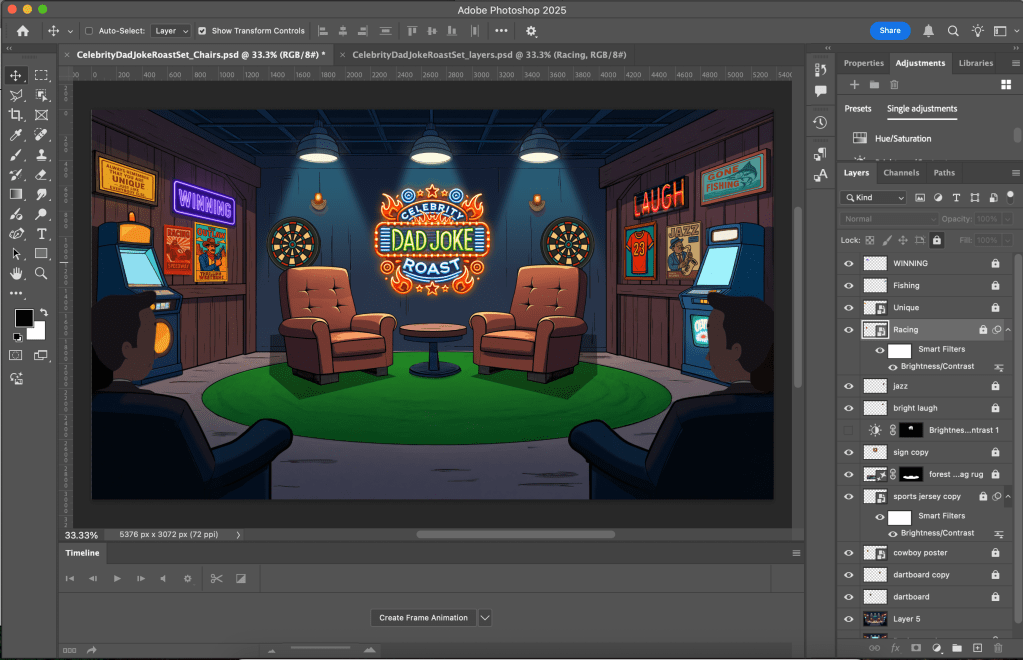
Image note: The final set feels exaggerated and theatrical, with the neon logo and bold green rug pulling the eye to the stage.
Takeaway
AI can help rough out a stage composition, but it can’t deliver the kind of visual humor and brand integration a comedy show needs. Every detail — from the rug to the logo placement — had to be reimagined to match the show’s personality.
Example 2: The Coffee Shop – The Black Hole Cosmic Coffee
After the stage, I needed Sunny Burn’s world: a cozy, artsy café where she works with her friends Shamar and Anita. Unlike the stage, this set had to be more grounded, sophisticated, and emotionally warm. If the stage was where Skip performed, the café was where Sunny figured out who she was.
AI Output
The AI generated a basic café: tables, a counter, some lighting. Structurally fine — but once again, the details were nonsense. Objects were misshapen, props had no personality, the overall look was dull and dingy, and random scribbles were everywhere. Nothing about it suggested this café had an identity of its own.
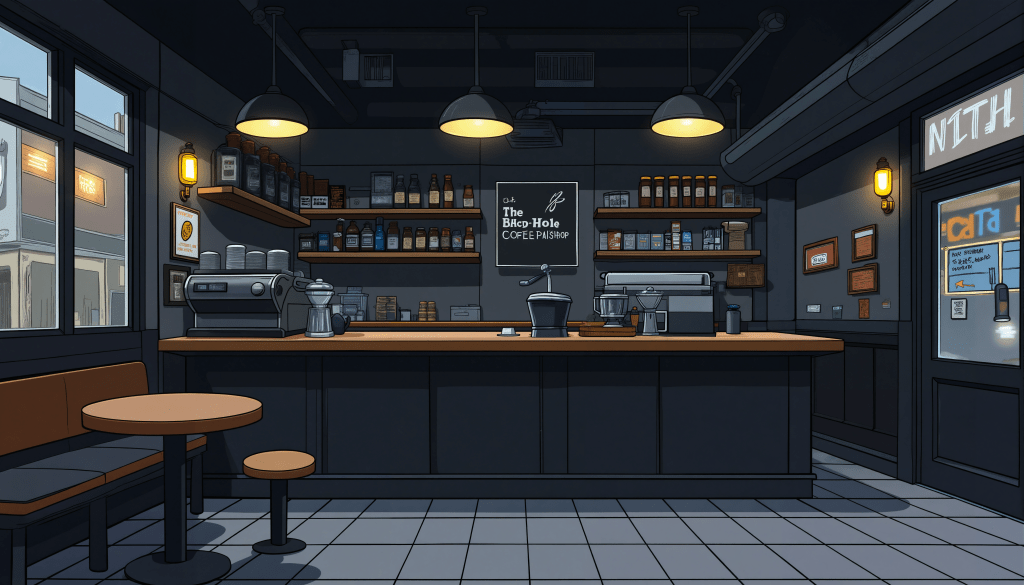
Image note: The AI output has the bones of a café but feels generic and cluttered — mismatched props and textures with no sense of character.
Final Artwork
To give the café its own personality, I named it The Black Hole Cosmic Coffee. The name reflected Sunny’s moody vibe, her artsy circle, and her talking cat who claims he’s the reincarnation of Kierkegaard. That mix of cosmic humor and existential edge inspired everything that followed.
I rebuilt the set in Photoshop, layer by layer:
- Branding everywhere — Designed a custom logo for the café and featured it on the counter, window decals, cups, and coffee bags
- Simplified layout — Removed distracting side doors, shelves, and random wall signage
- New furniture & décor — Added custom rugs, chairs, murals, and a pastry display
- Lighting & color — Brightened the space and leaned into sci-fi-inspired décor touches
- Polished details — Cleaned up AI scribbles on the walls and outside the window
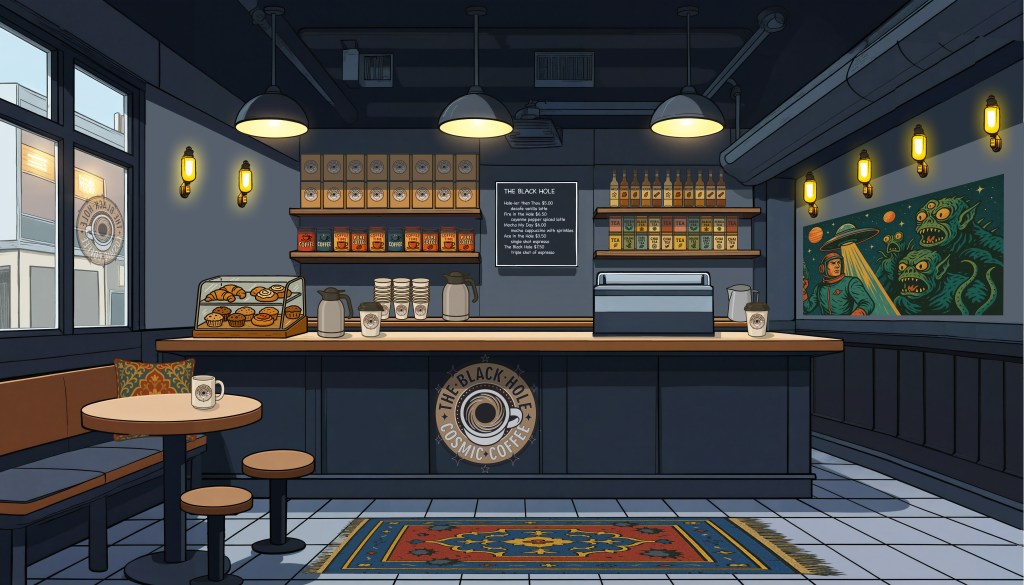
Image note: The final café feels branded and intentional — the logo anchors the design while warm lighting and décor give it character.
Takeaway
This was where I realized that AI is great at sketching a layout but terrible at inventing identity. Naming the café, creating a logo, and weaving in character lore transformed a generic backdrop into The Black Hole Cosmic Coffee — a set with narrative weight.
Example 3: The Green Room – “Start with an Empty Room”
By the time I got to the backstage set, I’d learned an important lesson: wrestling with AI’s cluttered, misshapen props wasted time. So instead of asking for a finished room, I prompted the AI for something simple — just an empty space.
AI Output
Even then, the results weren’t perfect. The ceiling was oddly low, the color palette was dull, and proportions still felt off. But the perspective and basic layout gave me a usable starting point.
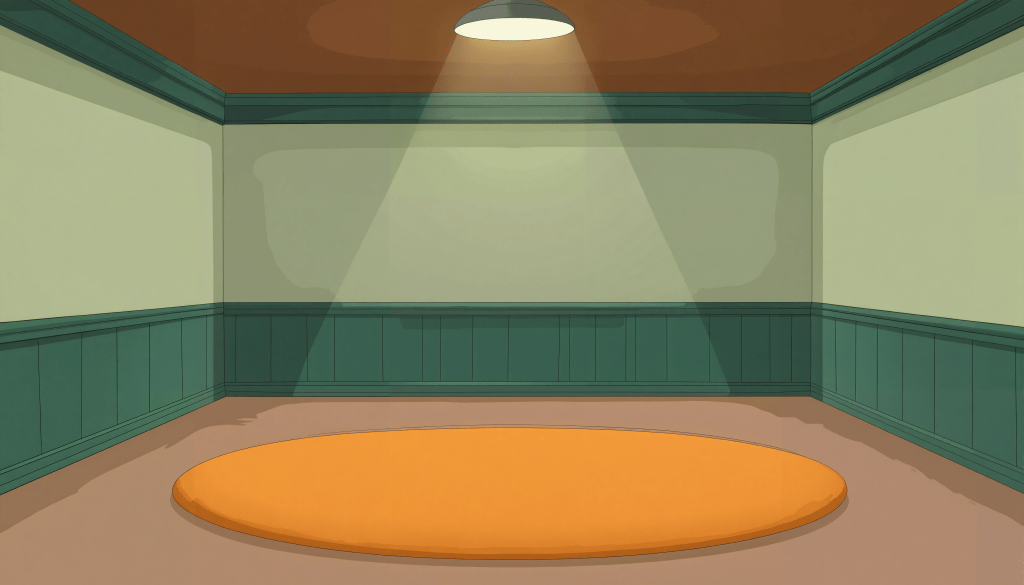
Image note: The empty room canvas offered scale and perspective, but the ceiling height and colors were all wrong.
Final Artwork
Photoshop became my main tool again — this time for structural surgery:
- Raised the ceiling — Adjusted proportions to make the space feel bigger and more theatrical
- Changed the palette — Recolored the ceiling from brown to white and brightened the floor and carpet
- Anchored the space — Added the show’s logo for continuity with the stage set
- Furnished from scratch — Built every chair, poster, and piece of décor myself to control style and proportion
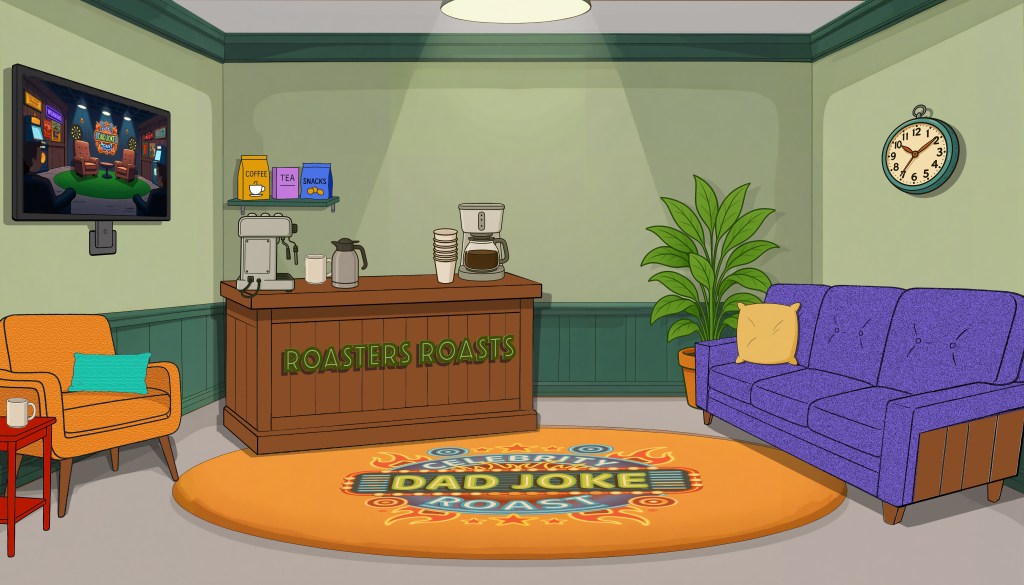
Image note: The final green room feels lived-in and theatrical, with furniture and props that match the show’s identity.
Takeaway
Sometimes the simplest approach is the most efficient. Asking for an empty room cut out the noise, letting me focus on decorating and customizing. AI gave me perspective, but I had to give the space personality.
How To Do This Yourself
If you want to use AI for set design, here’s a simplified workflow based on what worked for me:
1. Research first.
Pull reference images, build mood boards, and define a visual language. AI works best when you already know the look you’re chasing.
2. Write structured prompts.
Use the five-part formula (Context, Composition, Set Dressing, Lighting, Constraints). Don’t be afraid to write multiple versions — small wording shifts can change the whole result.
3. Iterate with AI.
Treat the AI output as a canvas, not a final product. Focus on getting the right layout and atmosphere, not perfect details.
4. Refine in Photoshop (or similar).
This is where the real design happens. Fix proportions, add custom branding, rebuild furniture, clean up AI artifacts, and adjust colors. If Photoshop isn’t your strength, hire a collaborator — platforms like Fiverr have affordable talent.
Pro Tip: Name your sets and give them identity early. When I named Sunny’s café The Black Hole Cosmic Coffee, everything from the logo design to the décor choices flowed naturally from that concept.
Closing Thought
The AI gave me something to push against. It helped me iterate visually faster, but it never did the creative work for me.That’s the real takeaway: AI is a collaborator in process, not in vision. By combining mood boards, prompt writing, and heavy manual edits, I built environments that fit Showrunner’s constraints and felt alive in the world of Celebrity Dad Joke Roast.
 Story Machine Studio LLC
2 responses to “Part 4: Building Sets with AI: Designing the World of Celebrity Dad Joke Roast”
[…] Part 4: Building Sets with AI: Designing the World of Celebrity Dad Joke Roast […]
LikeLike
[…] Coming up next: Part 4: Building Sets with AI: Designing the World of Celebrity Dad Joke Roast […]
LikeLike